Native courses
Spanish for Day-to-Day
React, shop, pay, chat and flat-hunt. Nine lessons covering the Spanish that daily life in Spain actually runs on — for when you live there, not just land there.
beginner → intermediate · 9 steps · 9 scenes

After this course you can
- React, agree and encourage with the tiny phrases natives say fifty times a day
- Tell the time, make plans and survive Spain's vague 'sobre las ocho'
- Shop at the market and the fitting room, then pay, split the bill and Bizum like a local
- Hold your own in the two small-talk topics that never run out: the weather and food
- Answer the phone, decode WhatsApp Spanish, and find yourself a flat
Survival gets you through the first days; this course is for everything after — the market stall, the group-chat, the bill that needs splitting, the flat that needs finding. It’s the Spanish of routines: small words, said constantly, that textbooks skip because they don’t look like grammar.
Each step pairs a lesson with a short practice session built from its real sentences. Read the lesson, do the practice — and when a step has a scene, play it too — and the next step unlocks. The order follows a day that slowly becomes a life: reactions and clock-time first, then shops, restaurants and money, then the long game — weather small talk, food opinions, phone calls, and finally a place of your own.
What's inside
Counted from the course itself. Nothing here is rounded up.
- 9 steps
- A lesson, a drill built from it, and a scene — in the order real life hands them to you.
- 9 scenes
- Branching conversations with no undo. Where you end up is wherever your replies took you, and you can always play it again.
- 73 drills
- Built from the sentences in the step they belong to: multiple choice, gap-fills, word order, matching.
- 235 native-speaker notes
- On the replies: what gives you away, and what somebody local would have said instead.
- 9 audio sessions
- Hands-free, and not a read-through: you get the prompt, then a silence to answer out loud in, then the answer. For the walk or the washing-up.
- A journal, and its review
- Phrases you earn in a scene are kept. Later the course hands them back and asks you to write them out from memory.
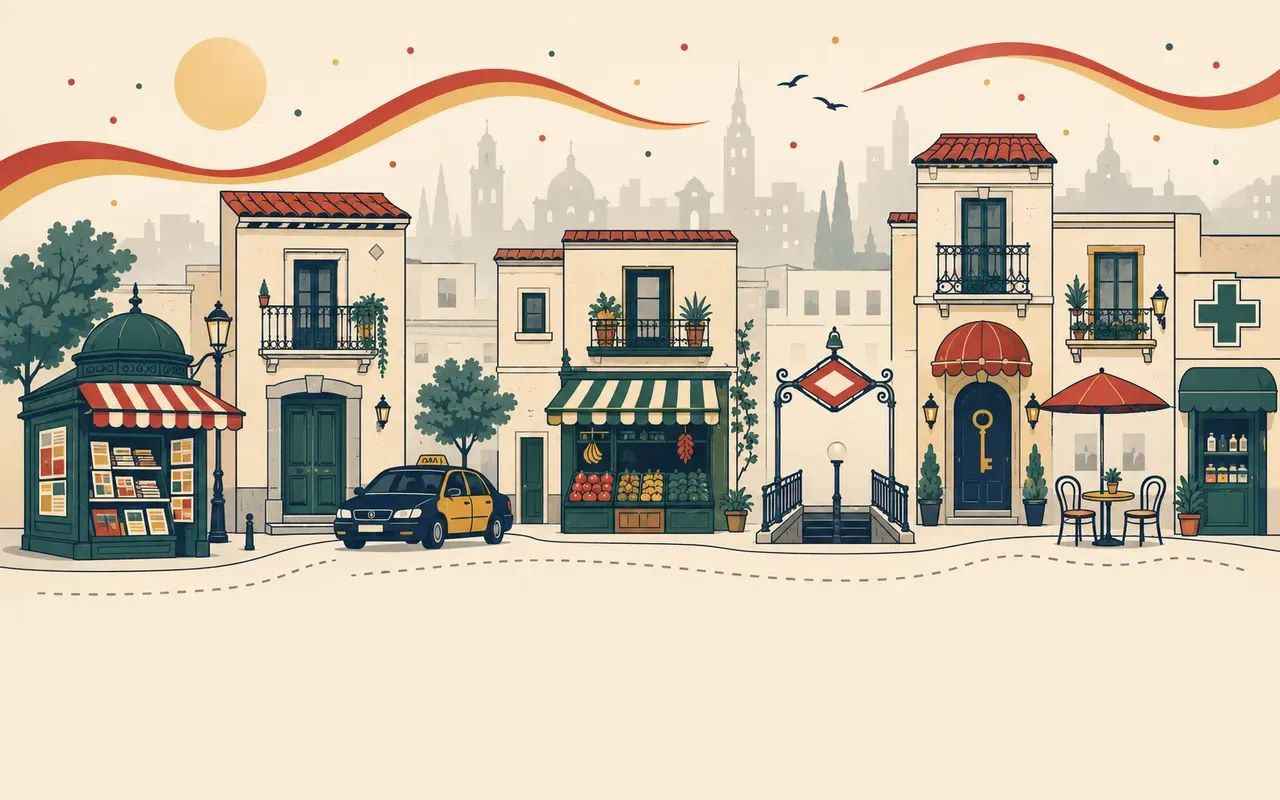 A map of the whole thing
- Every place the course takes you, on one board, opening as you get to it.
This is what a scene feels like
The opening of La escalera, the first scene of Spanish for Day-to-Day. You walk into it once step 1 is done.
El portal del número siete, en la calle del OlmoWith: Charo, la del tercero, El repartidor
You hear
Charo, la del tercero
¡Ay, hola, buenas! Otra vez el ascensor averiado, ¿eh? Y yo con toda la compra a cuestas.
Oh, hello there! The lift's out of order again, eh? And here's me with the whole shop on my back.
Your reply — pick one
- 1¡Madre mía! Deje, deje, que le subo yo una bolsa.Good grief! Here, let me — I'll carry a bag up for you.
- 2Sí, el ascensor no funciona. ¿Quiere que le ayude?Yes, the lift isn't working. Would you like me to help you?
- 3Buenos días. Espero que arreglen el ascensor pronto.Good morning. I hope they fix the lift soon.
What you find out after you choose
Understood, but clumsy
You said: Buenos días. Espero que arreglen el ascensor pronto.
Immaculate, and it lands like a note slid under a door. Neighbours passing on the stairs say 'buenas' — the clipped half of the greeting is the everyday one, and the full 'buenos días' belongs at a counter with a queue behind you. Then the wish: she is not waiting for the lift to be repaired, she is carrying the shopping up three floors right now. Spanish smalltalk answers the moment in front of it, not the topic.
235 notes like that one sit behind the replies in this course — not whether you were right, but what you sounded like.
Who these are for
You can walk into this one cold. Step one is a beginner lesson, so no Spanish is expected before it.
Who they are not for
- Anyone who needs a certificate. Nothing here maps to CEFR, nothing is examined, and no one is watching.
- Anyone who wants grammar tables. The grammar is inside the sentences, explained where it actually bites.
The pathway
Every step, in order. Your own progress lives on the page you play from.
Step 1 of 9 · beginner
Everyday Phrases Textbooks Never TeachReact, agree, disagree and encourage like a native — the tiny everyday Spanish phrases you hear constantly but never find in a textbook.
Step 2 of 9 · beginner
Telling the Time in Spanish: The Complete GuideHow to tell the time like a native — ser vs son, quarter past and quarter to, la madrugada, and the vocabulary for clocks and watches.
Step 3 of 9 · beginner
Shopping in Spanish: From Market Haggling to the Fitting RoomAsk prices like a local, survive the fitting room with quedar, and handle the rapid-fire checkout script without breaking a sweat.
Step 4 of 9 · intermediate
Ordering Food Like a LocalLearn the phrases that will make waiters smile and your dining experience in Spain infinitely better.
Step 5 of 9 · intermediate
Money Talk — Pay, Split and Save Like a NativeFrom splitting the bill to opening a bank account — the money vocabulary Spaniards really use, including how to say you are broke.
Step 6 of 9 · beginner
Weather Small Talk: Hace, Está, Hay and When to Use EachMaster the three weather verbs, complain about the heat like a local, grade the rain from drizzle to deluge — and never say estoy caliente by accident.
Step 7 of 9 · intermediate
Talking About Food Like a NativeDescribe flavours, confess your sweet tooth, and complain the soup needs salt — talk about food the way Spaniards actually do.
Step 8 of 9 · intermediate
Phone Calls and Texting Like a NativeAnswer the phone, survive a bad connection, and decode WhatsApp abbreviations — sound natural on the phone and in Spanish group chats.
Step 9 of 9 · intermediate
Finding a Home in Spain Like a NativeDecode Spanish flat adverts, talk to landlords with confidence, and describe your new home — the vocabulary flat-hunters actually need.
Before you start
Do I need an account?
No. There is nothing to sign up for. Your progress is kept in this browser, which means it is waiting when you come back — on this device, in this browser, and not on your phone as well.
What does it cost?
Nothing. Every course, every scene and every drill is free while we grow.
Where do I start?
At step one of whichever course matches where you are now. Everything after it stays shut until you have done the one before, so there is no order to get wrong.
Do I have to play the scenes?
Where a step has one, yes — playing it is part of what opens the next step. It is also the only place you have to produce the language with somebody waiting, which is the whole point of it.
Can I get it wrong?
In a scene, constantly: every reply gets an answer and the conversation carries on, because what opens the next step is having turned up, not how well it went. Drills are stricter — three lives, and running out means taking that step again. Either way nothing is lost but the run.
Start where you actually are.
Free while we grow. Your progress stays in this browser.